
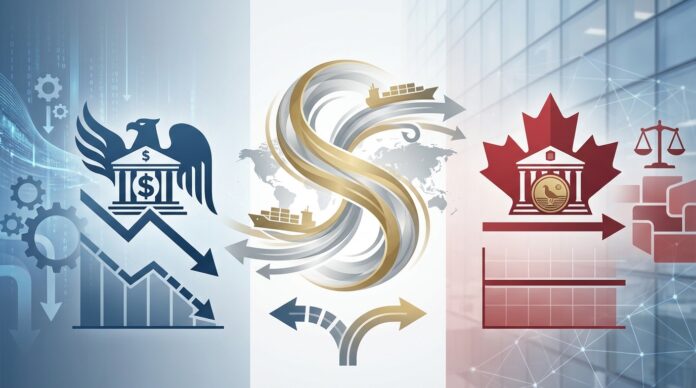
A Tale of Two Banks: Divergence Defies the Global Easing Narrative
For the first time in this cycle, the synchronized dance of North American central bankers has ended. On December 10, 2025, the Federal Reserve cut interest rates by 25 basis points—marking its third consecutive reduction—while the Bank of Canada chose to hold its key policy rate steady at 2.25%.
This divergence signals a critical shift in the macroeconomic landscape. While the U.S. acts to shore up a softening labor market, Canada is pausing to assess unexpected economic resilience amidst the looming threat of trade protectionism. For business leaders and borrowers, the signal is clear: the path to cheaper capital is becoming nonlinear, and bank liquidity is likely to tighten as uncertainty rises.
The Fed: The "Hawkish Cut"
Federal Reserve Chair Jerome Powell lowered the target range to 3.50%–3.75%, citing the need to support full employment. However, this was not a signal of unbridled easing. Powell explicitly stated the Fed is "well positioned to wait" before moving again, signaling a potential pause in January.
Crucially, the decision was marred by significant internal division. Three policymakers dissented—the highest number involving a rate decision since 2019. This discord within the Federal Open Market Committee (FOMC) suggests that while the floor for rates is lowering, the conviction behind further cuts is evaporating. The Fed is balancing on a knife’s edge: trying to prevent a recession without reigniting inflation stoked by new tariff policies.
The Bank of Canada: A Strategic Pause
North of the border, Governor Tiff Macklem held the overnight rate at 2.25%. Contrary to the recessionary fears earlier in the year, Q3 GDP and employment data beat expectations, suggesting the Canadian economy has absorbed recent shocks better than anticipated.
The BoC’s decision reflects a "wait-and-see" approach. With inflation hovering near 2% but core measures sticky around 3%, the Bank is reluctant to stimulate demand aggressively while the implications of U.S. trade wars—specifically tariffs on steel and aluminum—remain murky. Macklem noted that the current rate is "about the right level" to navigate this structural transition.
The Implication for Borrowers
A superficial reading of the headlines might suggest that capital is getting cheaper in the U.S. and staying stable in Canada. However, the reality of market access is far more complex.
1. The Liquidity Lag: A Fed rate cut does not immediately translate into easier loan approvals. Traditional banks, viewing the dissent at the Fed and the trade volatility alongside the BoC’s caution, are likely to tighten their credit boxes. They act on forward-looking risk, and the current outlook is murky.
2. The Cost of Uncertainty: The divergence between the Fed and BoC introduces FX volatility and cross-border complexity. When central banks disagree, risk premiums widen. We expect traditional lenders to increase spreads to compensate for this macro uncertainty, effectively negating the benefit of the Fed’s 25 basis point cut for many middle-market borrowers.
3. The Private Advantage: While public markets digest mixed signals and banks retreat to committee meetings to debate the tariff impacts, private credit remains the solution for certainty. At Bond Capital, we underwrite the business, not the headline. In an environment where the Fed is braking and the BoC is idling, the agility of private capital becomes a decisive competitive advantage.


