
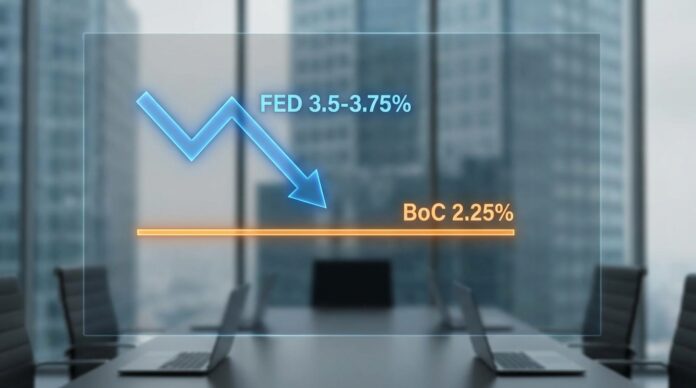
A Tale of Two Central Banks
December 10 marked a pivotal moment in North American monetary policy as the United States Federal Reserve and the Bank of Canada signaled diverging strategies for the coming year. The Federal Reserve, responding to mounting downside risks in the American labor market, reduced its benchmark interest rate by 25 basis points to a target range of 3.5% to 3.75%. This marks the third consecutive rate cut from the Fed, yet Chair Jerome Powell signaled this easing cycle may be pausing, projecting as few as one additional cut in 2026.
Conversely, the Bank of Canada (BoC) maintained its overnight rate at 2.25%. Governor Tiff Macklem cited unexpected resilience in the Canadian economy—specifically a 2.6% GDP growth print in the third quarter—as justification for the hold. While inflation in Canada is hovering near the 2% target, the BoC remains in a ‘wait-and-see’ mode, assessing the structural impact of U.S. trade protectionism before adjusting the cost of capital.
The Data Driving the Divide
The decision to cut in the U.S. was driven largely by cracks in the employment picture. Chair Powell noted that headline job growth figures might be overstated, suggesting the labor market is weaker under the surface than official data implies. This concern for employment now rivals the Fed’s focus on inflation. The decision was not without contention; the Fed saw three dissenting votes, highlighting a significant internal split on whether the economy needs more liquidity or continued restraint.
North of the border, the narrative is reversed. Despite looming tariff threats, the Canadian economy has outperformed expectations. However, this stability is fragile. The BoC is keenly aware that the upcoming review of the Canada-United States-Mexico Agreement creating uncertainty for business investment. The ‘resilience’ cited by the Bank is viewed by many strategists as temporary armor against a potentially volatile trade environment in 2026.
The Credit Market Reality: Rates Down, Credit Tight
For borrowers, the headline rate figures can be misleading. While the Fed is lowering the floor, traditional lenders are raising the drawbridge. The uncertainty surrounding future tariff impositions and the divergence in North American policy creates a complex risk environment for commercial banks. In scenarios where macro-volatility exists—such as the current trade tensions—traditional banks typically tighten their credit boxes regardless of the overnight rate.
What this means for your business: A lower federal funds rate does not immediately translate to accessible capital. There is a ‘lag effect’ where policy easing takes months to trickle down to commercial loan books. Furthermore, with the BoC holding rates steady, Canadian borrowers should not anticipate an immediate reduction in their cost of debt.
The Bond Capital Perspective
When central banks diverge and geopolitical trade policies cloud the horizon, volatility is the only certainty. Traditional lenders react to this uncertainty by retreating to the sidelines. Bond Capital interprets this environment differently. We view the current ‘hold’ in Canada and the ‘cautious cut’ in the U.S. as a signal that private liquidity is essential for growth.
While Tier 1 banks pause to reassess their risk models in light of tariff potential and labor softness, Bond Capital focuses on the asset value and the business model today. We provide the certainty of execution that public markets currently lack, bridging the gap between today’s volatility and tomorrow’s stabilized rate environment.


