
The Era of Automatic Rate Cuts Is Over
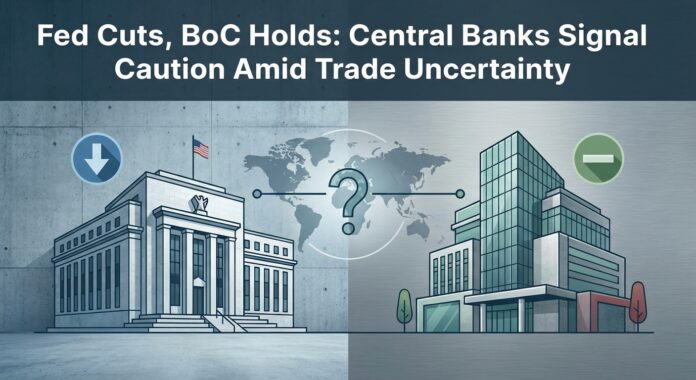
In a decisive week for North American monetary policy, a clear divergence has emerged between the Federal Reserve and the Bank of Canada, though the underlying message from both is identical: caution.
On Wednesday, the Federal Reserve cut its benchmark interest rate by 25 basis points to a target range of 3.5% to 3.75%. This marks the third consecutive cut for the U.S. central bank. However, the accompanying commentary from Chair Jerome Powell was stark, signaling that this may be the last reduction for the foreseeable future. With officials projecting only one cut in 2026, the Fed is effectively pivoting to a "wait and see" stance as it balances softening labor data against the inflationary risks of new tariffs.
Conversely, the Bank of Canada (BoC) held its key overnight rate steady at 2.25%. Governor Tiff Macklem cited the unexpected resilience of the Canadian economy—despite the pressure of U.S. tariffs on steel, aluminum, and lumber—as the primary driver for maintaining the status quo. While the BoC acknowledges that the economy is transitioning through a structural shift, the decision to hold emphasizes that Canadian policymakers are no longer in a rush to stimulate.
The Trade War Premium
The macroeconomic backdrop for both decisions is heavily influenced by the resurgence of trade protectionism. The imposition of tariffs has created a complex environment where traditional economic models are struggling to predict outcomes.
- In the U.S.: The Fed is forced to navigate a dual mandate under stress. While the labor market shows signs of cooling (prompting cuts), the inflationary pressure from tariffs prevents them from committing to an aggressive easing cycle.
- In Canada: The BoC is effectively pricing in trade volatility. While headline unemployment has dropped to 6.5%, the central bank explicitly noted that uncertainty regarding regarding the Canada-United States-Mexico Agreement acts as a governor on growth.
For business owners, this creates a environment of elevated uncertainty. While headline rates in Canada remain low at 2.25%, the perception of risk in the broader market is rising.
What This Means for Borrowers
The headline rate is only one component of the cost of capital. The spread—the premium lenders charge over that base rate—is determined by risk appetite. When Central Bank Governors use words like "murky" and "uncertain," Schedule A banks inevitably contract their credit boxes.
We are entering a period where traditional lenders will likely pause to assess the impact of trade policies on borrower solvency, particularly in export-heavy sectors like manufacturing and forestry. Even with the BoC rate holding low, access to liquidity may tighten as banks restructure their risk models to account for tariff-induced volatility.
For companies navigating this structural transition, private credit offers a strategic advantage. Unlike traditional institutions paralyzed by policy uncertainty, flexible capital providers can underwrite the specific operational realities of a business, looking past the macroeconomic fog to support growth and stability.


